
Does Bleach Remove Mold? The Honest Answer
Bleach can kill or inactivate mold on some cleanable surfaces when used as directed, but it does not remove every affected material or fix the moisture source. If you choose bleach, the CDC's mold-cleanup guidance specifies no more than 1 cup of household bleach in 1 gallon of water. Follow the product label and never mix bleach with another cleaner.
The CDC says bleach or dish detergent can be used to clean mold, depending on the amount of water damage and where the growth is located. The EPA does not recommend chlorine bleach as a routine mold-cleanup practice, although it notes that professional judgment may support using a biocide in some situations.
Those positions sound more contradictory than they really are. Bleach can reduce viable mold on some surfaces when it is used correctly. It still does not replace the parts that matter most: removing the growth, correcting the moisture source, drying the area, and deciding whether the affected material can actually be cleaned.
Bleach may be one tool for a small, cleanable surface. It is not a shortcut around moisture control, physical cleaning, drying, or removing damaged material.
What Is the Bleach-to-Water Ratio for Mold?
The CDC's mold-cleanup instructions give a maximum of 1 cup of household bleach per gallon of water. That is 1 part bleach to 16 parts water by volume. The smaller amounts below are equivalent proportions, not stronger mixtures.
| Water | Maximum household bleach |
|---|---|
| 1 gallon (16 cups) | 1 cup (8 fluid ounces) |
| 1 quart (4 cups) | 1/4 cup (4 tablespoons) |
| 1 pint (2 cups) | 1/8 cup (2 tablespoons) |
This is a maximum in CDC's mold guidance, not a requirement to use bleach. Follow the label for the product and surface, including any lower dilution. Detergent and water may be sufficient for a small, cleanable area. A stronger solution does not solve growth inside damaged drywall or insulation.
What Bleach Concentration Should You Use?
Read the sodium hypochlorite percentage on the bottle. Household bleach strengths vary, so the same volume does not always give the same final concentration. The CDC's general bleach guidance describes regular unscented household bleach with 5% to 9% sodium hypochlorite and emphasizes following the label. Do not substitute concentrated, scented, or splashless products without appropriate directions.
How Long Should Bleach Stay on Mold?
Use the contact time and application instructions on the product label. There is no single contact time that establishes a complete mold cleanup on every material. Remove the growth, follow any rinsing instructions, and dry the surface. If the mold returns, investigate moisture or hidden material instead of repeatedly applying bleach.
Video transcriptI Think My Home Has Mold. Do I Need to Call a Removal Company?
I think my home has mold. Do I need to call a removal company? If you suspect mold in your home, it is crucial to address it swiftly due to the potential health risks, especially for children, people with immune suppression, or people with underlying lung diseases. Mold is not always visible. It can hide behind walls, under floors, or in ceilings, making it challenging to detect without professional help. For visible mold in a small area, you might manage cleaning it yourself with proper safety gear.
However, considering the health implications and the possibility of hidden mold, it is wise to consult a professional mold inspection company. They can accurately assess the situation, find hidden mold, and determine the extent of the infestation. At Mold and Air Duct Pros, we specialize in both mold inspection and mold remediation. We can help you identify mold issues, safely remove them, and take measures to prevent future growth.
By addressing both visible and hidden mold, we help make sure your home is safe and healthy while reducing the risks associated with mold exposure. If you need to schedule a mold inspection or remediation, please contact Mold and Air Duct Pros at (440) 467-4104 today.
Killing Mold Is Not the Same as Removing It
This is the most important distinction in the whole conversation.
The EPA notes that dead mold may still trigger allergic reactions for some people, so simply killing it is not enough. The growth still needs to be removed. The moisture problem also needs to be corrected, or mold may return regardless of which cleaner was used.
Bleach can lighten staining, which can make a surface look better quickly. A color change alone does not tell you whether the material is clean, dry, structurally sound, or free of hidden growth.
What the Research Actually Shows
The evidence is more useful than either extreme of “bleach fixes everything” or “bleach never works.”
A 2012 household and laboratory study tested a 2.4% sodium hypochlorite solution against Aspergillus fumigatus. In controlled testing, it reduced culturable mold by more than 3 to more than 6 log10 and reduced measured allergen levels by an average of 95.8%. The study included nonporous and porous ceramic carriers.
That result shows that sodium hypochlorite can inactivate mold under defined conditions. It does not prove that spraying bleach on drywall, insulation, framing, or a wet wall cavity completes a real-world remediation.
Another study of mold-damaged gypsum board and pinewood compared ten remediation treatments, then tested the materials after drying and remoistening. None of the tested methods completely eliminated viable mold. The practical takeaway is that the material, depth of growth, moisture history, application method, and cleanup process all matter.
The Surface Matters More Than the Cleaner
Hard, Nonporous Surfaces
Tile, glass, metal, and many hard plastic surfaces are generally the most cleanable. The EPA's basic guidance is to scrub mold from hard surfaces with detergent and water, then dry them completely.
If you choose to use bleach, follow the product label and current CDC safety guidance. Do not assume that a stronger mixture is better.
Wood, Concrete, and Other Semiporous Materials
Some structurally sound wood and concrete can be cleaned, but the right method depends on the condition and extent of the material. Surface whitening is not a reliable clearance test. The area still needs to be physically cleaned and dried, and the source of moisture needs to be addressed.
Drywall, Insulation, Ceiling Tile, and Carpet
Absorbent materials are a different problem. The EPA says moldy porous materials such as ceiling tile and carpet may need to be discarded because mold can grow in the spaces and crevices within the material. Its remediation guidance also identifies drywall and insulation as materials that may require removal when they cannot be cleaned and dried.

A Practical Decision Guide
A Small Patch on Bathroom Tile
This may be a reasonable DIY cleanup if the total affected area is less than about 10 square feet, the water source is clean, the surface is sound, and nobody doing the work is in a higher-risk group. Fix the moisture source, clean the surface, and dry it thoroughly.
The EPA's 10-square-foot guideline is a general cleanup threshold, not a line between “safe” and “dangerous.” The location, material, hidden extent, and people in the home still matter.
Mold on Drywall or Insulation
Bleach is unlikely to settle the real question: can the material be cleaned and dried, or does it need to be removed? If drywall is swollen, deteriorated, repeatedly wet, or hiding a damp cavity, replacing the affected material may be the more reliable approach.
Mold That Keeps Returning
Recurring growth usually points to an unresolved moisture problem, incomplete cleaning, hidden affected material, or some combination of the three. Reaching for a stronger chemical does not fix a leak, condensation, high humidity, or a wet wall cavity.
Mold Near an HVAC System or After Contaminated Water
If mold may involve the HVAC system, or the water source includes sewage or other contamination, stop and get qualified help. These situations require a different level of assessment, protection, and containment.
If You Choose to Use Bleach, Use It Carefully
Bleach can injure skin and eyes, damage materials, and release dangerous vapors when it is misused. A few non-negotiables:
- Never mix bleach with ammonia or any other cleaner or disinfectant.
- Read and follow the product label. Household bleach concentrations vary.
- Ventilate the area with fresh outdoor air while using cleaning products indoors.
- Wear gloves and eye protection. For mold disturbance, CDC guidance also recommends at least a NIOSH-approved N95 respirator. An N95 filters particles; it does not protect against bleach vapors.
- The CDC's mold guidance says to use no more than 1 cup of household bleach in 1 gallon of water. That is a maximum, not a reason to use bleach when detergent and water are sufficient.
- Dry the cleaned surface quickly and completely.
People with asthma, COPD, immune suppression, or other concerns about mold exposure should not take part in the cleanup. If you have personal health questions, speak with a qualified healthcare professional.
When Professional Mold Remediation Makes Sense
Consider bringing in an experienced mold professional when:
- The visible area is larger than about 10 square feet.
- Growth is hidden, widespread, or keeps returning.
- Drywall, insulation, carpet, or other porous materials may need removal.
- The HVAC system may be involved.
- The water source may include sewage or other contaminants.
- Occupants or workers may be more vulnerable to mold exposure.
- You need containment, documentation, or post-remediation testing.
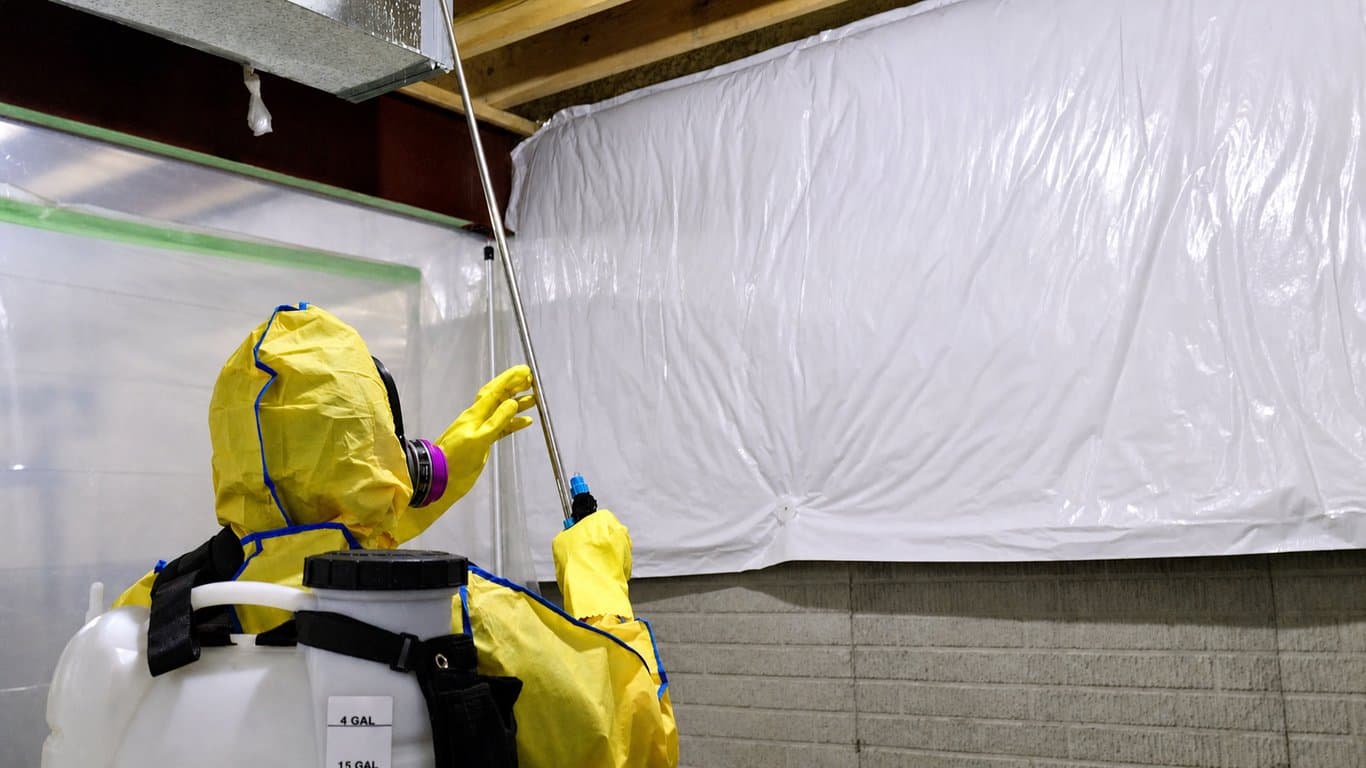
Professional remediation is not just “using a stronger product.” A complete scope may include moisture investigation, containment, removal of unsalvageable material, detailed cleaning, HEPA air control, and a final evaluation of the finished work.
Sources and Further Reading
- EPA: Should I use bleach to clean up mold?
- EPA: Basic mold cleanup steps
- EPA: Mold cleanup in your home
- CDC: Mold cleanup guidelines and bleach safety
- CDC: Cleaning and disinfecting with bleach
- Journal of Occupational and Environmental Hygiene: sodium hypochlorite efficacy study
- Journal of Environmental Monitoring: building-material remediation study
FAQs
Does bleach kill mold?
Bleach can inactivate mold on some surfaces when the concentration, contact time, and application are appropriate. Killing mold is not the same as removing the growth, drying the area, or correcting the moisture source.
What is the bleach-to-water ratio to kill mold?
CDC mold-cleanup guidance specifies no more than 1 cup of household bleach per gallon of water, equivalent to 1 part bleach to 16 parts water. For one quart of water, the same proportion is 1/4 cup of bleach. Follow the product label and never mix bleach with other cleaners.
Can I use undiluted bleach on mold?
Do not assume full-strength bleach is more effective or appropriate. Follow the product's dilution and surface instructions. Stronger bleach can damage materials and increases exposure to the product without fixing hidden growth or moisture.
Does bleach kill black mold?
Bleach can inactivate mold under suitable conditions, but the color does not determine the cleanup method. The material, extent, and moisture source matter more. A dark patch on tile is a different problem from mold throughout damaged drywall.
Can I use bleach on moldy bathroom tile?
Bleach may be used on some hard, cleanable surfaces if the product label allows it. The EPA also recommends detergent and water for hard-surface mold cleanup. Whichever method you choose, never mix cleaners, ventilate the room, use appropriate protection, and dry the surface completely.
Should moldy drywall be replaced?
Sometimes. Drywall that is swollen, deteriorated, repeatedly wet, or affected beyond the cleanable surface may need to be removed. The condition, moisture source, and extent of growth determine whether it can be salvaged.
When is DIY mold cleanup reasonable?
The EPA says an area smaller than about 10 square feet can often be handled by the homeowner. DIY may not be appropriate when growth is extensive or hidden, porous materials are damaged, the HVAC system is involved, the water is contaminated, or someone in the home is at greater risk from exposure.