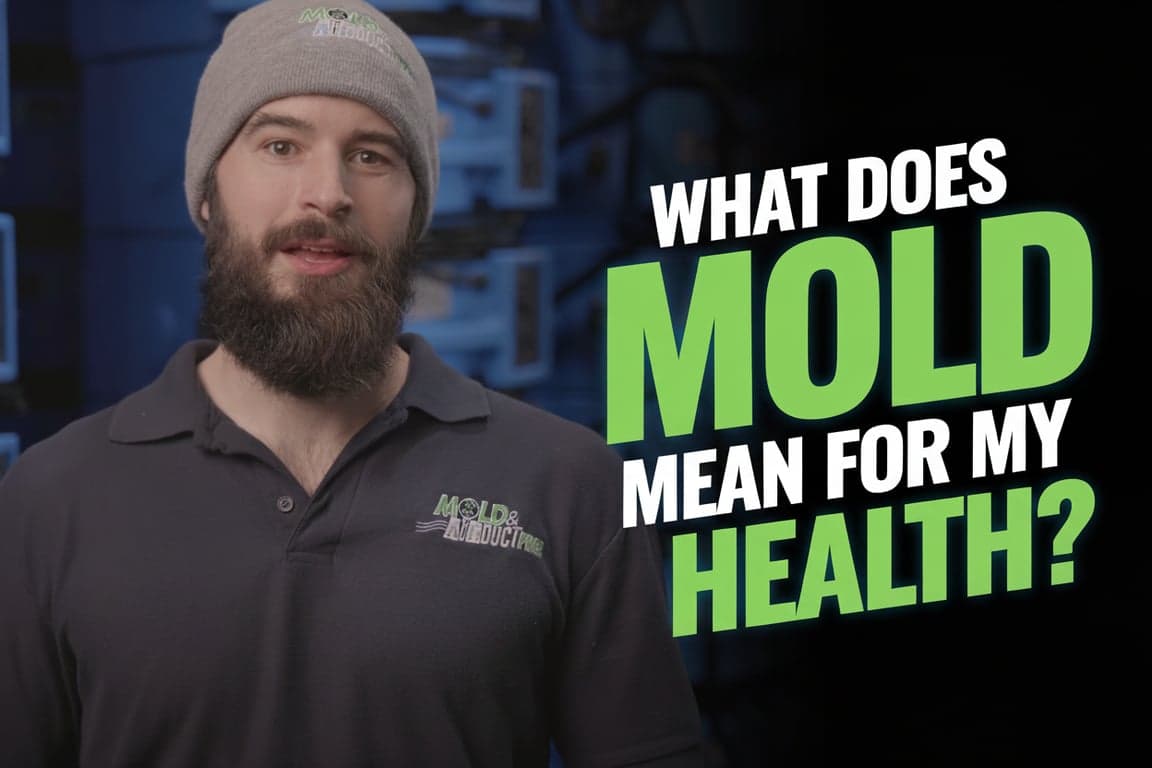

Video transcriptWhat Does Mold Mean for Me and My Health?
What does mold mean for me and my health? Hi, I'm Josh from Mold and Air Duct Pros, based in Cleveland, Ohio. There are over 100,000 species of mold, and each person's body may react differently to each mold type. The elderly, infants, young children, individuals with immune suppression, or those with underlying lung disease may be more sensitive to mold exposure and may experience more severe symptoms.
The most common mold-related symptoms are nasal stuffiness, throat irritation, coughing or wheezing, eye or skin irritation, headaches, lack of mental clarity, or in more severe cases, fever and difficulty breathing. Allergic reactions may happen immediately or develop after a period following exposure. Both growing mold and even dead mold spores may lead to allergic reactions. That's why we HEPA vacuum each square inch of the contaminated area after the treatment, to remove the dead mold spores.
Mold has been known to cause asthma attacks in people who have asthma and are allergic to mold. Regardless of your health condition, it's best to stay on top of any mold issues in your home or office and take proper steps to protect yourself. If you have any concerns about potential mold in your home or office, give Mold and Air Duct Pros a call at (440) 467-4104.
Finding mold can make your whole house feel questionable overnight. You may wonder whether it is safe to sleep there, whether your children should leave, or whether opening a window is enough until somebody can inspect it.
The honest answer is that there is no universal yes or no. A small patch on one bathroom wall is different from mold across several rooms after a flood. The people in the home, the amount and location of growth, the moisture source, and any symptoms all matter.
A small, isolated mold problem does not automatically make an entire house uninhabitable. However, indoor mold growth should be addressed promptly. The CDC says people with asthma, COPD, or immune suppression should not stay in a moldy home or be there during cleanup. Everyone else should limit exposure, stay out of the affected area, correct the moisture source, and choose a cleanup plan that fits the actual conditions.
This guide can help you make a practical building decision. It cannot tell you whether mold caused a symptom or provide personal medical advice. A qualified healthcare professional handles health questions; an experienced mold professional evaluates the building.
Is It Safe to Stay in a House With Mold?
Sometimes people can remain in an unaffected part of the home while a small, isolated concern is addressed. Sometimes temporarily staying elsewhere is the more sensible choice.
Start with four questions:
- Who is in the home? Asthma, COPD, mold allergies, immune suppression, and other medical factors can change the level of concern.
- How much of the home is affected? One cleanable surface is different from widespread growth, multiple damp rooms, or damage after a major water event.
- Can the affected area be avoided? Mold in a closed basement storage room presents a different practical problem than mold beside a bed, throughout a finished living space, or near an HVAC return.
- Is the moisture still active? A continuing leak, wet materials, or elevated humidity gives the problem room to grow and can make the eventual cleanup larger.
The CDC explains that damp and moldy environments may cause health effects for some people and none for others. That variation is why a neighbor's experience, the color of the growth, or a single air reading cannot answer the occupancy question for your household.
Who Should Avoid a Moldy Home?
The CDC's mold-cleanup guidance is direct about several higher-risk groups. People with asthma, COPD, or immune suppression should not stay in a moldy home or be present while it is being cleaned.
The same guidance says people with mold allergies, immune suppression, underlying lung disease, asthma, or COPD should not perform the cleanup. Children should also stay out of the work area and should not participate in mold cleanup.
Consider staying elsewhere and contacting a healthcare professional when:
- Someone in the household is in one of those higher-risk groups.
- Breathing, allergy-like, eye, or skin symptoms become worse in the home.
- A person has persistent symptoms and is unsure how much exposure is reasonable.
- The affected area cannot be separated from sleeping or essential living areas.
If anyone has severe trouble breathing or another medical emergency, leave the area and seek emergency care. Do not wait for a mold inspection to make a medical decision.
When Does Temporarily Leaving Make Sense?
There is no official air-test number or square-foot measurement that decides whether every person must leave. Temporary relocation is a case-by-case decision, but it becomes more reasonable when:
- Mold or water damage affects several rooms or a large portion of the home.
- The home was flooded or the water may contain sewage or other contamination.
- Mold may be inside the HVAC system or close to a return-air intake.
- Demolition, removal of damaged drywall, or another dust-producing process is underway.
- The work area cannot be contained from the occupied part of the house.
- A resident's symptoms improve away from the home and return or worsen inside it.
- A healthcare professional recommends avoiding the building.
During professional remediation, occupants should follow the containment and access plan for that project. A properly contained work area is not a room to walk through, check on, or use for storage until the work and evaluation are complete.

What Should You Do If Mold Is Limited to One Room?
If the concern appears isolated and nobody in the home is in a higher-risk group, these steps can reduce unnecessary exposure while you arrange cleanup:
- Keep people and pets out of the affected room as much as practical.
- Avoid brushing, sanding, cutting, or tearing out moldy material without a plan. Disturbing it can release more particles.
- Stop the leak or moisture source if you can do so safely.
- Do not aim a portable fan across visible growth or from the affected room into the rest of the house.
- Keep indoor humidity no higher than 50 percent when possible, which is the CDC's general mold-prevention recommendation.
- If you know or suspect the HVAC system itself is contaminated, the EPA says not to run it because it may spread mold through the building.
- Decide promptly whether the material can be cleaned or needs to be removed.
Opening a window may provide ventilation during appropriate cleaning, but it does not remove mold, dry a hidden cavity, or repair a leak. In humid Northeast Ohio weather, an open window may not help with moisture at all. Treat ventilation as one possible precaution, not the solution.
Does the Amount of Mold Change the Answer?
Yes, but size is not the only factor.
The EPA says a moldy area smaller than about 10 square feet can often be cleaned by a homeowner. That is a general cleanup guideline, not a declaration that every smaller area is safe or every larger area requires evacuation.
A small project may still deserve professional help when:
- Mold is on drywall, insulation, carpet, ceiling tile, or another porous material.
- The growth keeps returning after cleaning.
- A musty odor suggests there may be hidden growth.
- The moisture came from sewage or contaminated water.
- The HVAC system may be involved.
- Someone in the home is at greater risk from exposure.
- You would need to open a wall or disturb a concealed area to understand the problem.
Hard, nonporous surfaces are generally easier to clean than absorbent materials. If you are weighing a small cleanup, our guides explain the limits of using bleach on mold and the risks of disturbing mold without the right protection.
What Symptoms Can Mold Exposure Cause?
People do not all respond to mold in the same way. According to the CDC, some people may have no effects. Others may experience:
- A stuffy nose or sore throat.
- Coughing or wheezing.
- Burning, red, or itchy eyes.
- Skin irritation or a rash.
- Worsening asthma or a stronger allergic reaction.
People with immune suppression or chronic lung disease may face a risk of lung infection. The CDC also summarizes evidence linking damp indoor environments with upper-respiratory symptoms, cough, wheeze, asthma symptoms in people with asthma, and hypersensitivity pneumonitis in susceptible individuals.
These symptoms are not unique to mold. A building inspection cannot diagnose an illness, and a medical test cannot locate a wet wall. If symptoms are persistent, worsening, or concerning, discuss them with a healthcare professional and tell them when and where they occur. Our related guide covers what mold may mean for your health in more detail.
What If the Mold Is Black?
Color alone does not tell you how dangerous a mold condition is or whether you can remain in the house.
Stachybotrys chartarum is one greenish-black mold that receives a lot of attention. The CDC says it is not necessary to identify the type before taking action. Stachybotrys and other indoor molds should be treated the same with respect to potential health risks and removal.
In plain English, do not ignore black growth, but do not let the color create a panic that distracts from the useful questions: Where is the moisture coming from? How far does the growth extend? What material is affected? Who may be exposed? What must be cleaned or removed?
Can Mold Testing Tell You Whether the House Is Safe?
Not by itself.
The CDC does not recommend routine home mold testing to predict whether someone will become sick. The EPA also says sampling is usually unnecessary when visible mold is already present, and no federal limits define an acceptable indoor concentration of mold or mold spores.
Testing can still answer a specific building question when the source is hidden, conditions may involve more than one room, a baseline is needed before remediation, or a post-remediation comparison is part of the project. The method and interpretation have to fit the question.
When we use InstaScope during an inspection and testing appointment, it measures and classifies airborne biological particles room by room and lets us review the findings on site. It does not identify individual mold species, diagnose symptoms, or turn one number into a medical clearance. We combine the readings with the moisture history, visual inspection, material conditions, and layout of the home.
What Should You Do Today?
You do not need to solve the whole project in the first hour. Start with the decisions that prevent more exposure and more damage:
- Protect the people first. Keep higher-risk occupants away from the moldy home or area and contact their healthcare professional for personal advice.
- Stop active water. Repair or isolate a leak when it is safe to do so. Drying and moisture control are essential because mold will keep growing while materials stay damp.
- Do not disturb the area casually. Skip dry brushing, sanding, demolition, and the household fan pointed at the growth.
- Document what you see. Take photographs and note the location, approximate size, odor, moisture history, and affected materials.
- Choose the right level of help. A small hard-surface patch may be a reasonable DIY project. Hidden, recurring, widespread, porous-material, HVAC, or contaminated-water concerns often call for an experienced professional.
- Verify the finished work. The moisture problem should be corrected, visible growth and moldy odor should be gone, and the area should remain dry without new signs of damage.

How We Help Northeast Ohio Homeowners
We begin with the question you are actually trying to answer. Is this one visible patch? Could there be a hidden moisture problem? Does the concern extend beyond the room where you noticed it? Is professional remediation warranted, or is a smaller cleanup reasonable?
Depending on the situation, our process may include:
- A free visual consult to review what you are seeing.
- Moisture readings, thermal imaging, and a careful visual inspection.
- Room-by-room airborne testing with on-site results when testing will add useful information.
- A written scope that explains what can be cleaned and what may need removal.
- Containment, HEPA air control, material removal, and detailed cleaning.
- A post-remediation evaluation backed by our 100% Mold Remediation Guarantee.
We can evaluate the home and explain the building work. We will never pretend that an inspection replaces advice from your doctor.
FAQs
Is It Safe to Sleep in a Room With Mold?
It is better to avoid sleeping in a room with visible mold or an unresolved moisture problem until the area is evaluated and cleaned. This is especially important for anyone with asthma, COPD, immune suppression, mold allergies, or symptoms that worsen in the room.
Do I Need to Leave My House If I Find Mold?
Not every small, isolated patch requires everyone to leave the entire house. Consider the people in the home, the size and location of the problem, whether the affected area can be avoided, and whether cleanup will disturb materials. The CDC says people with asthma, COPD, or immune suppression should not stay in a moldy home or be present during cleanup.
How Long Can You Stay in a House With Mold?
There is no universal safe number of hours or days. Exposure and health effects vary, and indoor mold growth should be corrected promptly. If you must remain temporarily, avoid the affected area, reduce moisture, do not disturb the growth, and arrange the appropriate cleanup.
Does Opening Windows Make a Moldy Room Safe?
No. Fresh-air ventilation may be useful during some cleaning work, but an open window does not remove mold or fix its moisture source. Outdoor humidity can also work against drying, particularly during a humid Northeast Ohio summer.
Is Black Mold More Dangerous Than Other Mold?
Color is not a reliable measure of risk. The CDC says Stachybotrys chartarum and other indoor molds should be treated the same with respect to potential health risks and removal. Any indoor mold growth needs moisture correction and appropriate cleanup.
Can a Mold Test Prove That a House Is Safe to Occupy?
No single mold test can provide a medical clearance or predict how every person will react. Testing can support a building assessment when it answers a defined question, but results must be interpreted alongside visual conditions, moisture, affected materials, and the people using the space.