
Our whole-home mold inspection in Cleveland costs $550 for homes up to 2,500 total square feet, including the basement. For larger homes, the estimate is $0.25 per total square foot. A 5,000-square-foot home is approximately $1,250. Start with a free visual consult to find out whether a paid inspection fits your concern.
The inspection service combines a visual review, moisture investigation, whole-home airborne readings, and targeted surface screening. This guide explains what those steps include and how the pricing works.
Video transcriptHow Much Does a Mold Inspection Cost?
Zach: Mark, a homeowner is concerned with a possible mold issue in their home and they’re considering doing a mold inspection. How much does a mold inspection service cost with our company?
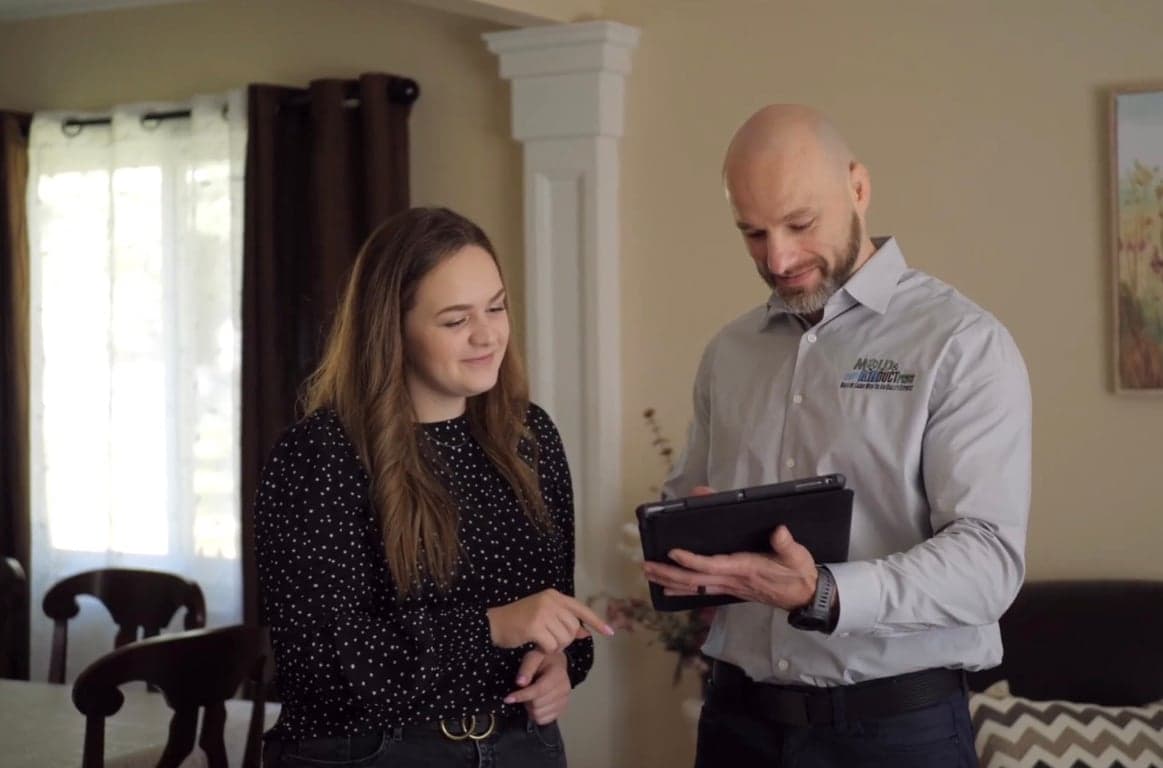
Mark: Great question, Zach. The way it starts is with a free visual consult. This is no cost and no obligation to the homeowner. Ultimately, we want to make sure we’re a good fit for what they have going on in the house.
During the free visual consult, we go through areas where there are potential issues or questions. Typically, I like to focus on areas with a water source – bathrooms, showers, and sometimes the basement.
That first step is the free visual consult because we don’t want to charge people for a service they don’t need.
Zach: Exactly. And if you think they’re a good candidate for the inspection, the next step is doing the inspection. How much does the inspection cost and what does it include?
Mark: Sure. Our approach to mold inspections is three-pronged.
Mark: Number one is a more thorough visual inspection. What separates that from the initial walkthrough is that I bring additional tools. For instance, we’ll use an infrared camera to see if there’s moisture escaping, heat differences, or areas that are questionable – because we don’t have see-through vision. We can’t see behind walls, ceilings, or drywall, but infrared helps identify concerns.
And other tools as well. But really the most important thing to us is ensuring the health and safety of the occupants.
That’s where we introduce the InstaScope. This is state-of-the-art technology – basically our lab on wheels. In a given volume of space in question, it helps us understand what’s airborne.
What’s nice about this inspection is it’s not just covering the area in question – it covers the whole home. Because how do you know it’s not airborne in other parts of the house? It can move through the air throughout the home.
Zach: Exactly.
Mark: Zach, I can’t tell you how many times – if you don’t mind me sharing a story – a homeowner had an issue in the basement, agreed to the assessment, and whatever was in that basement was starting to become airborne throughout the rest of the living space – like the living room and dining room.
So it’s a way for us to get a good understanding – almost like a scan of what’s going on in the home.
Now the biggest question you’re probably going to ask is, “What if you don’t find anything? What if I see something suspicious?”
That’s where we get our swab test involved. This is how we confirm that something suspicious is actually mold. There’s a chemical reaction that occurs. Imagine I go to a surface area, take a sample, put it in a vial, break the vial, and a liquid pours down the tube. A chemical reaction happens, and one of two things occurs:
- Either there’s no mold, or whatever is visual is not mold
- Or it confirms the presence of microbial growth consistent with mold
Mark: All that costs $550 for a house up to 2,500 square feet. Anything above that is $0.25 per square foot.
Zach: Got it. So let’s say it’s a 5,000 square foot house – we’re talking $1,250 for a bigger house.
Mark: Correct.
Zach: And that inspection isn’t just doing the air test – and not just in a couple rooms. You’re doing air testing in the entire house.
Mark: Correct.
Zach: And you’re also testing any visual microbial growth that could potentially be mold.
Mark: Correct. The reason behind testing is to give answers to questions. The question is – how do I know what I don’t know?
Because there are other companies that come out and they don’t believe in testing. They just say everything is mold and you need to remediate it.
And we’re just not that company. We want to make sure that when we come out, homeowners align with our values.
I always make this joke – I never want to see you again for this reason.
Zach: Yeah – like a doctor.
Mark: Exactly. We want to give the homeowner peace of mind when we’re done. A lot of people have kids, dogs, loved ones, elderly family members. We’re not their health professional, but we want them to leave with peace of mind that they had a professional in the home, that the process was objective, and they weren’t taken advantage of.
It starts as a free visual consult, and if it needs to go further, it goes further.
Zach: Sounds good. Thank you, Mark.
Mark: Thank you.
What the free visual consult covers
We start with a free visual consult. Show us the area you’re concerned about and tell us about any recent leaks, dampness or musty odors. We’ll explain whether a paid inspection would help.

What a paid mold inspection includes
If you decide to go ahead with a paid inspection, here’s what we check.
Visual inspection, moisture readings and thermal imaging
The inspector looks over the home and uses tools such as moisture meters and an infrared camera to investigate suspect areas. Thermal imaging shows temperature patterns. The inspector compares those patterns with moisture readings and what they can see before drawing a conclusion.
Room-by-room air testing with InstaScope
The InstaScope gives us airborne readings during the visit. We test room by room so we can compare the area that brought us out with the rest of the house.

Surface swab testing when needed
We may take a swab from a surface that looks like it has mold. We use the swab for on-site screening and may recommend further investigation or lab analysis if you need more detail.
Mold inspection pricing
A full inspection costs $550 for homes up to 2,500 square feet, including the basement. For larger homes, the estimate is 25 cents per total square foot. A 5,000-square-foot home would be about $1,250. That covers the visual inspection, whole-home air testing and swabs as needed.
What you receive after testing
We explain what we found before we leave and give you a written report. If removal or a moisture repair is needed, we tell you which areas need attention and why.
Mold Inspection Cost Calculator
Estimate your mold inspection cost
Enter the total square footage across every level we will test, including finished or unfinished basements.
$550 for homes up to 2,500 sq. ft. For larger homes, the estimate is $0.25 per total sq. ft.
Final scope and price are confirmed after the free visual consult.
What Happens During an Inspection?
From the first walkthrough to a room-by-room plan.
- Step 1
Free visual consult
We walk the home, look at the areas that concern you, and decide whether testing is needed.
- Step 2
Whole-home testing
Infrared and moisture tools guide the inspection. InstaScope compares airborne readings room by room, with targeted swab testing when needed.
- Step 3
Results and next steps
We explain the findings, answer your questions, and provide a clear plan only where the results support it.
FAQs
How much does a mold inspection cost in Cleveland, OH?
A comprehensive mold inspection in Cleveland, Ohio costs $550 for homes up to 2,500 sq ft. For larger homes, the estimate is $0.25 per total square foot, including the basement. This price includes a visual inspection, whole-home airborne readings, and swab testing as needed.
Is the free visual consult the same as a paid inspection?
No. The free visual consult reviews the concern and helps determine the next step. The paid whole-home inspection adds tools, measurements, and a report. We explain the proposed service before you commit.
Does the inspection price include mold removal?
No. Remediation is a separate scope based on the findings. Our Cleveland mold remediation cost guide explains the published project example and the work included.